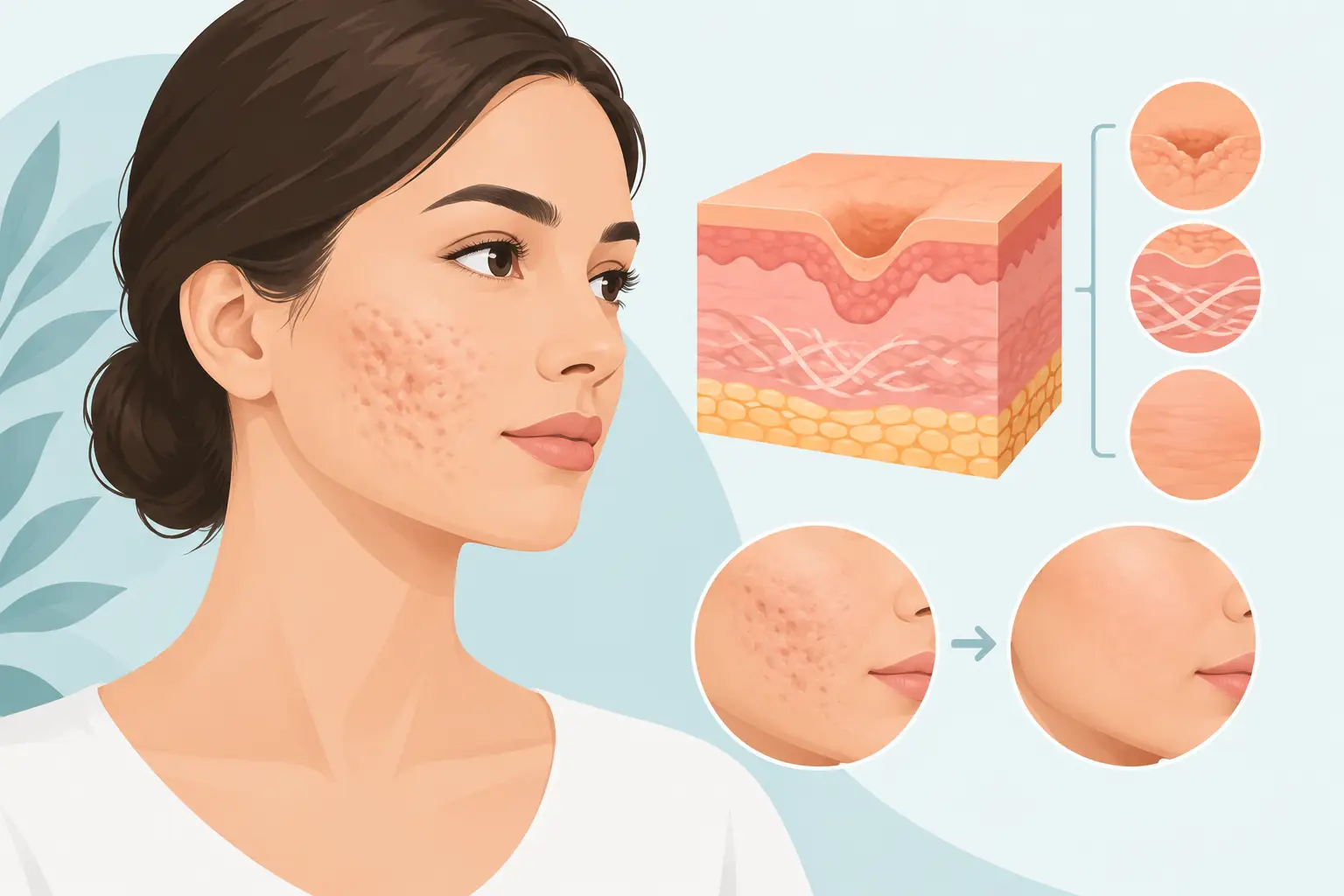
A scar can feel like a reminder that lasts longer than the breakout itself. So, can acne scars be removed? In many cases, they can be softened significantly and made less noticeable. Complete removal is not always realistic, because a scar is a lasting change in the skin’s structure. But with an accurate diagnosis and a thoughtful treatment plan, skin texture, color variation, and overall clarity can improve meaningfully.
The most helpful first step is not choosing the newest device or the most talked-about treatment. It is understanding what kind of scar is present, whether acne is still active, and how your skin tends to heal. Those details shape both the treatment choice and the pace of care.
Can Acne Scars Be Removed Completely?
The honest answer is: it depends. Some shallow marks respond very well to treatment and become difficult to notice in everyday light. Deeper scars may improve substantially but still remain visible on close inspection. A goal of smoother, more even-looking skin is usually more realistic and more helpful than promising perfectly unmarked skin.
Acne scars are not all the same. Some are indentations caused by lost collagen after inflammation. Others are raised, firm areas caused by excess scar tissue. What many people call scars may instead be lingering red, pink, brown, or gray marks after a breakout. These color changes can fade over time and often need a different approach than a true textural scar.
A careful consultation distinguishes among these concerns. Treating redness as though it were a deep indentation, or using an aggressive resurfacing treatment on skin that is still breaking out, can lead to frustration and unnecessary downtime. The right plan begins with a close look at the skin rather than a one-size-fits-all package.
Why Scar Type Changes the Treatment Plan
Indented acne scars are commonly grouped by their shape. Ice-pick scars are narrow and deep, often resembling tiny punctures. Boxcar scars have clearer edges and a wider, more defined depression. Rolling scars create gentle waves or shadows across the skin because fibrous bands pull the surface downward.
Each type responds differently. A narrow, deep scar often needs a focused approach rather than broad surface treatment alone. Rolling scars may improve when the tethering beneath the skin is addressed, sometimes alongside collagen-stimulating treatment. Wider, shallow scars may respond well to resurfacing or other techniques that support gradual skin remodeling.
Raised scars require even more caution. They are more common on the jawline, chest, shoulders, and back, and may need treatments designed to flatten and calm excess scar tissue. Because raised scars can be prone to recurrence, they should not be treated with the same assumptions used for indented facial scars.
Many people have a combination of scar types. This is why a layered plan is often more effective than repeating one treatment for every concern. One approach may improve depth, another may refine surface texture, and another may address remaining discoloration.
Treat Active Acne Before Chasing Old Scars
When new acne is still appearing, controlling inflammation is usually the priority. Treating scars while breakouts continue can feel like trying to repair a road while new damage is being made. It may also increase the risk of new marks, irritation, and uneven healing.
For some patients, acne control is straightforward and can be combined with gentle skin-supporting care. For others, the skin barrier needs time to recover before any procedure is considered. This is especially true when acne treatments have caused dryness, peeling, or sensitivity.
A practical plan may begin with medical acne management, a simplified home routine, and regular assessment of how the skin is responding. Once breakouts are stable, scar treatment can be introduced more confidently. The timeline is personal, but the sequence matters.
Common Options for Acne Scar Improvement
There is no single best treatment for every acne scar. The most appropriate option depends on scar shape, depth, skin tone, acne activity, lifestyle, and tolerance for downtime. A clinician may recommend one method or carefully combine several over time.
Microneedling and collagen-focused treatments
Microneedling creates controlled microchannels in the skin to encourage collagen remodeling. It can be useful for certain shallow, widespread indented scars and for overall texture. Results develop gradually because collagen renewal takes time, often over several months and through a series of sessions.
Radiofrequency microneedling may be considered for some patients when a deeper remodeling effect is appropriate. However, more intensity is not automatically better. Settings should be selected carefully, especially for skin that is sensitive or prone to post-inflammatory discoloration.
Resurfacing treatments
Laser or other energy-based resurfacing treatments can improve uneven texture and help blend the edges of shallow scars. They may also be useful when enlarged pores, fine lines, or dullness are part of the concern.
The trade-off is recovery. Depending on the method and intensity, the skin may be red, dry, swollen, or temporarily more sensitive. People with medium to deeper skin tones need individualized planning because excessive inflammation can trigger unwanted pigment changes. Sun protection and careful aftercare are central to a safe outcome.
Subcision for tethered scars
Some rolling scars are held down by fibrous bands beneath the skin. Subcision is a technique that releases these bands so the surface can lift more naturally over time. It may be paired with other treatments when volume loss or broader texture concerns are also present.
Bruising and swelling can occur, and improvement is gradual rather than immediate. The benefit is that it addresses a structural reason the scar is depressed, rather than only treating the surface above it.
Focused treatment for deep, narrow scars
Deep, narrow scars may need a highly localized technique. Depending on the scar and skin assessment, a clinician may use a targeted chemical reconstruction method or another focused procedure. These approaches require precision, since surrounding healthy skin should be protected.
They are often used as part of a broader plan rather than as a standalone answer. A person may first improve deep individual scars, then later work on the overall texture of the skin.
Skin Tone, Lifestyle, and Healing Matter
A treatment that works well for one person may not be the right first choice for another. Skin tone affects the likelihood of temporary or persistent pigment changes after inflammation. A history of keloids, slow healing, frequent cold sores, eczema, or recent tanning can also influence treatment decisions.
Lifestyle matters, too. If you cannot avoid strong sun exposure, have an important event approaching, or cannot accommodate visible redness or peeling, timing should be adjusted. Good care respects real life rather than forcing a treatment schedule that is difficult to maintain.
At Somsei Clinic, this type of planning is part of a one-to-one approach: identifying the concern that will make the biggest visible difference, then recommending only the care that fits the skin and the person in front of us.
What Results Should You Expect?
Acne scar treatment is usually a process, not a single appointment. Some improvements may be seen after the skin settles, but collagen remodeling and pigment fading take time. Photos taken in consistent lighting can be more useful than checking the mirror every day, where shadows can make scars look different from one moment to the next.
It is also normal for progress to be uneven. One area of the face may improve quickly while another needs a different technique. A good plan allows for reassessment instead of assuming the original recommendation must stay fixed.
At home, gentle care helps protect the investment in treatment. Use sunscreen consistently, avoid picking at active blemishes, and be cautious with strong exfoliants or multiple new products during recovery. If acne is active, follow the treatment plan designed to reduce new inflammation.
When Is It Time for a Scar Consultation?
Consider an evaluation if your scars affect how you feel in photos, makeup does not sit smoothly, or you find yourself avoiding certain lighting or social situations. You do not need to wait until scars feel severe to ask what may help. Early guidance can also prevent wasted time on products that cannot reach the structural cause of a deep scar.
The most reassuring path is one built around your actual skin, not an idealized before-and-after image. With precise treatment, patience, and a plan that evolves as your skin does, acne scars can become a quieter part of your story rather than the first thing you see.







A scar can feel like a reminder that lasts longer than the breakout itself. So, can acne scars be removed? In many cases, they can be softened significantly and made less noticeable. Complete removal is not always realistic, because a scar is a lasting change in the skin’s structure. But with an accurate diagnosis and a thoughtful treatment plan, skin texture, color variation, and overall clarity can improve meaningfully.
The most helpful first step is not choosing the newest device or the most talked-about treatment. It is understanding what kind of scar is present, whether acne is still active, and how your skin tends to heal. Those details shape both the treatment choice and the pace of care.
Can Acne Scars Be Removed Completely?
The honest answer is: it depends. Some shallow marks respond very well to treatment and become difficult to notice in everyday light. Deeper scars may improve substantially but still remain visible on close inspection. A goal of smoother, more even-looking skin is usually more realistic and more helpful than promising perfectly unmarked skin.
Acne scars are not all the same. Some are indentations caused by lost collagen after inflammation. Others are raised, firm areas caused by excess scar tissue. What many people call scars may instead be lingering red, pink, brown, or gray marks after a breakout. These color changes can fade over time and often need a different approach than a true textural scar.
A careful consultation distinguishes among these concerns. Treating redness as though it were a deep indentation, or using an aggressive resurfacing treatment on skin that is still breaking out, can lead to frustration and unnecessary downtime. The right plan begins with a close look at the skin rather than a one-size-fits-all package.
Why Scar Type Changes the Treatment Plan
Indented acne scars are commonly grouped by their shape. Ice-pick scars are narrow and deep, often resembling tiny punctures. Boxcar scars have clearer edges and a wider, more defined depression. Rolling scars create gentle waves or shadows across the skin because fibrous bands pull the surface downward.
Each type responds differently. A narrow, deep scar often needs a focused approach rather than broad surface treatment alone. Rolling scars may improve when the tethering beneath the skin is addressed, sometimes alongside collagen-stimulating treatment. Wider, shallow scars may respond well to resurfacing or other techniques that support gradual skin remodeling.
Raised scars require even more caution. They are more common on the jawline, chest, shoulders, and back, and may need treatments designed to flatten and calm excess scar tissue. Because raised scars can be prone to recurrence, they should not be treated with the same assumptions used for indented facial scars.
Many people have a combination of scar types. This is why a layered plan is often more effective than repeating one treatment for every concern. One approach may improve depth, another may refine surface texture, and another may address remaining discoloration.
Treat Active Acne Before Chasing Old Scars
When new acne is still appearing, controlling inflammation is usually the priority. Treating scars while breakouts continue can feel like trying to repair a road while new damage is being made. It may also increase the risk of new marks, irritation, and uneven healing.
For some patients, acne control is straightforward and can be combined with gentle skin-supporting care. For others, the skin barrier needs time to recover before any procedure is considered. This is especially true when acne treatments have caused dryness, peeling, or sensitivity.
A practical plan may begin with medical acne management, a simplified home routine, and regular assessment of how the skin is responding. Once breakouts are stable, scar treatment can be introduced more confidently. The timeline is personal, but the sequence matters.
Common Options for Acne Scar Improvement
There is no single best treatment for every acne scar. The most appropriate option depends on scar shape, depth, skin tone, acne activity, lifestyle, and tolerance for downtime. A clinician may recommend one method or carefully combine several over time.
Microneedling and collagen-focused treatments
Microneedling creates controlled microchannels in the skin to encourage collagen remodeling. It can be useful for certain shallow, widespread indented scars and for overall texture. Results develop gradually because collagen renewal takes time, often over several months and through a series of sessions.
Radiofrequency microneedling may be considered for some patients when a deeper remodeling effect is appropriate. However, more intensity is not automatically better. Settings should be selected carefully, especially for skin that is sensitive or prone to post-inflammatory discoloration.
Resurfacing treatments
Laser or other energy-based resurfacing treatments can improve uneven texture and help blend the edges of shallow scars. They may also be useful when enlarged pores, fine lines, or dullness are part of the concern.
The trade-off is recovery. Depending on the method and intensity, the skin may be red, dry, swollen, or temporarily more sensitive. People with medium to deeper skin tones need individualized planning because excessive inflammation can trigger unwanted pigment changes. Sun protection and careful aftercare are central to a safe outcome.
Subcision for tethered scars
Some rolling scars are held down by fibrous bands beneath the skin. Subcision is a technique that releases these bands so the surface can lift more naturally over time. It may be paired with other treatments when volume loss or broader texture concerns are also present.
Bruising and swelling can occur, and improvement is gradual rather than immediate. The benefit is that it addresses a structural reason the scar is depressed, rather than only treating the surface above it.
Focused treatment for deep, narrow scars
Deep, narrow scars may need a highly localized technique. Depending on the scar and skin assessment, a clinician may use a targeted chemical reconstruction method or another focused procedure. These approaches require precision, since surrounding healthy skin should be protected.
They are often used as part of a broader plan rather than as a standalone answer. A person may first improve deep individual scars, then later work on the overall texture of the skin.
Skin Tone, Lifestyle, and Healing Matter
A treatment that works well for one person may not be the right first choice for another. Skin tone affects the likelihood of temporary or persistent pigment changes after inflammation. A history of keloids, slow healing, frequent cold sores, eczema, or recent tanning can also influence treatment decisions.
Lifestyle matters, too. If you cannot avoid strong sun exposure, have an important event approaching, or cannot accommodate visible redness or peeling, timing should be adjusted. Good care respects real life rather than forcing a treatment schedule that is difficult to maintain.
At Somsei Clinic, this type of planning is part of a one-to-one approach: identifying the concern that will make the biggest visible difference, then recommending only the care that fits the skin and the person in front of us.
What Results Should You Expect?
Acne scar treatment is usually a process, not a single appointment. Some improvements may be seen after the skin settles, but collagen remodeling and pigment fading take time. Photos taken in consistent lighting can be more useful than checking the mirror every day, where shadows can make scars look different from one moment to the next.
It is also normal for progress to be uneven. One area of the face may improve quickly while another needs a different technique. A good plan allows for reassessment instead of assuming the original recommendation must stay fixed.
At home, gentle care helps protect the investment in treatment. Use sunscreen consistently, avoid picking at active blemishes, and be cautious with strong exfoliants or multiple new products during recovery. If acne is active, follow the treatment plan designed to reduce new inflammation.
When Is It Time for a Scar Consultation?
Consider an evaluation if your scars affect how you feel in photos, makeup does not sit smoothly, or you find yourself avoiding certain lighting or social situations. You do not need to wait until scars feel severe to ask what may help. Early guidance can also prevent wasted time on products that cannot reach the structural cause of a deep scar.
The most reassuring path is one built around your actual skin, not an idealized before-and-after image. With precise treatment, patience, and a plan that evolves as your skin does, acne scars can become a quieter part of your story rather than the first thing you see.