A jawline can look softer for more than one reason. It may be early skin laxity, a gradual shift in facial volume, muscle activity around the lower face, or changes in the skin’s firmness. That is why thread lift versus ultrasound lifting is not simply a question of which treatment is stronger. The better question is which approach matches the layer of concern, the degree of change you want, and the recovery time that feels realistic for you.
Both treatments are commonly considered by people who want a more rested, defined appearance without surgery. Yet they work differently, create different types of change, and ask for different levels of aftercare. A careful consultation should begin with your facial structure and skin condition, not with a preset treatment menu.
Thread lift versus ultrasound lifting: the essential difference
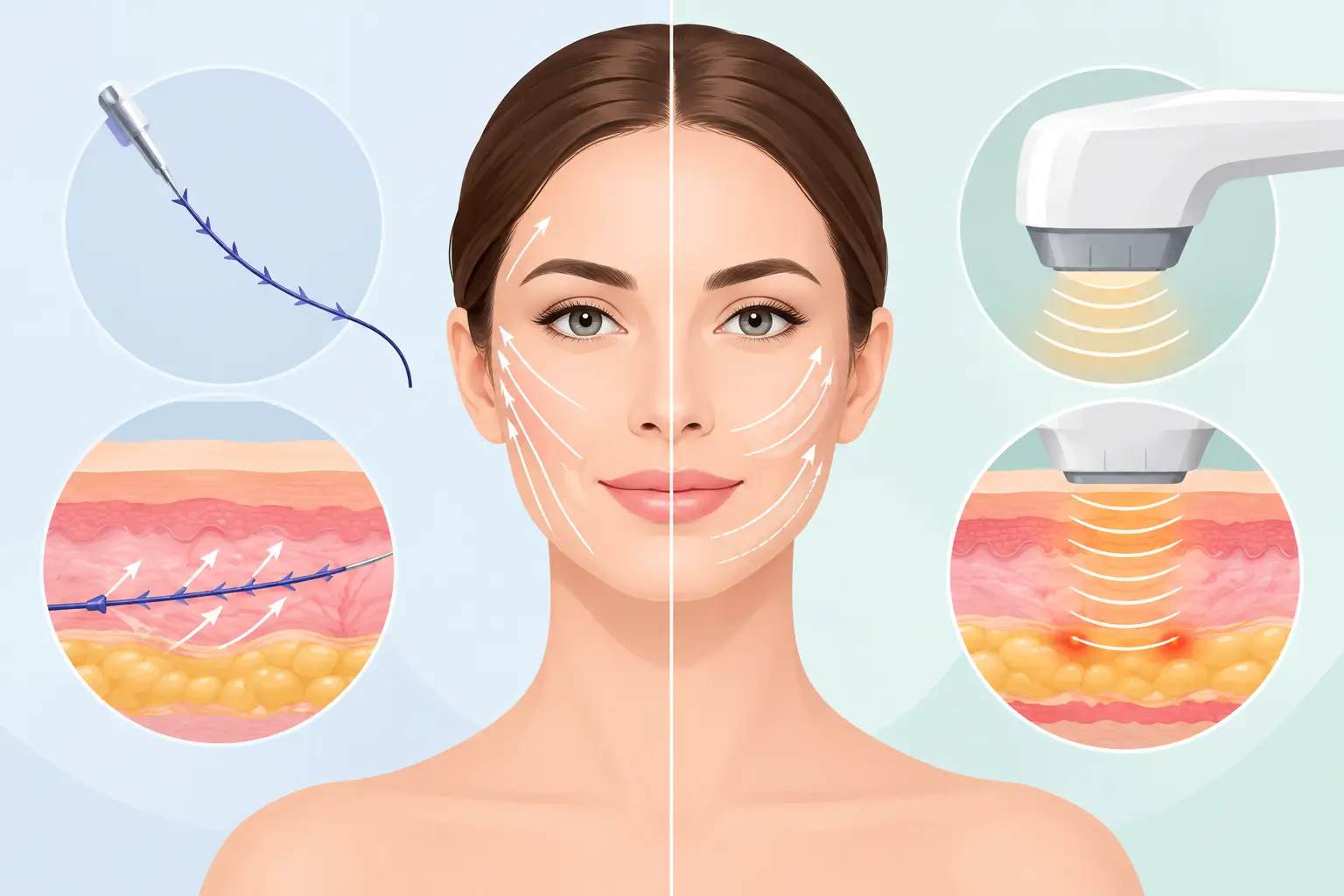
A thread lift uses absorbable medical threads placed beneath the skin through small entry points. Depending on the type and placement of the thread, it can provide a mechanical lifting effect by gently repositioning selected tissue. The threads are also intended to stimulate a gradual collagen response as they dissolve over time.
Ultrasound lifting delivers focused ultrasound energy to targeted depths below the skin surface. The energy creates controlled thermal points, encouraging collagen remodeling and tissue tightening over the following weeks and months. No threads are inserted, and there is usually no visible change immediately after treatment.
In simple terms, threads may be more appropriate when a clinician sees tissue that could benefit from measured repositioning. Ultrasound lifting is often considered when the primary goal is gradual firmness and a subtle tightening effect. These categories can overlap, but they should not be treated as interchangeable.
What a thread lift can address
Thread lifting is often discussed for the midface, jawline, lower cheek, and areas where mild to moderate sagging affects facial contour. Its appeal is that it may create an earlier visible change than energy-based treatments. For some people, this is useful before an important event, provided there is sufficient time for swelling or bruising to settle.
However, a thread lift is not a substitute for a surgical facelift. It has limits, especially with significant skin laxity, heavier tissue, or a large amount of volume loss. Pulling too aggressively can look unnatural and may increase the chance of visible irregularities. The goal should be a refreshed contour that still looks like you.
After a thread lift, tenderness, swelling, bruising, and a temporary pulling sensation can occur. Some people notice minor dimpling or asymmetry early in healing. These concerns often improve as the tissues settle, but proper placement, appropriate thread selection, and careful follow-up matter greatly. For a short period, patients may be asked to limit wide mouth movements, strong facial massage, and strenuous activity.
Results vary by thread type, anatomy, skin quality, and lifestyle. The immediate repositioning effect may soften over time, while collagen-related improvement develops more gradually. Many patients see benefits for months rather than years, although the duration is individual.
When threads may not be the first choice
If the concern is mainly crepey texture, diffuse looseness, or early loss of firmness without a clear area to reposition, threads may add more intervention than needed. Active skin inflammation, infection near the planned treatment area, certain medical conditions, and unrealistic expectations also require a more cautious approach. A clinician should review medical history and examine the skin before recommending treatment.
What ultrasound lifting can address
Ultrasound lifting is usually chosen for patients who prefer a gradual, noninvasive approach to mild skin laxity. It can be used in areas such as the brow, cheeks, jawline, and under-chin region, depending on the device, treatment plan, and individual anatomy.
Because the treatment works through collagen remodeling, the result tends to emerge slowly. Some people notice a slight early tightening, but the more meaningful change often appears over two to three months as new collagen develops. This timeline can suit someone who wants refinement rather than an obvious overnight shift.
Most patients return to normal routines shortly after ultrasound lifting. Temporary redness, swelling, sensitivity, tingling, or tenderness may occur. During treatment, the sensation can range from brief warmth to deeper discomfort at the energy points. Comfort measures and energy settings should be tailored thoughtfully rather than standardized for every face.
Ultrasound lifting is also not designed to create dramatic lifting in advanced laxity. If the jawline has changed substantially or the lower face carries significant heaviness, an energy-only treatment may produce a modest result. Being honest about that limitation is part of responsible care.
Skin quality still matters
Ultrasound energy can support firmness, but it does not replace treatment for every skin concern. Pigmentation, acne scarring, dehydration, enlarged pores, and fine surface lines may need separate attention. A face can have a tighter contour and still benefit from a skin-focused plan. This is one reason a treatment should be designed around the whole condition of the skin, not a single device.
Choosing based on your goal, not the trend
The decision between threads and ultrasound often becomes clearer when the desired change is stated precisely. If your priority is a more immediate improvement in a localized contour, a thread lift may be worth discussing. If you prefer gradual tightening with little interruption to daily life, ultrasound lifting may fit more naturally.
Age alone does not determine the answer. A person in their 30s may have lower-face laxity that responds well to carefully placed threads, while someone in their 50s may have excellent skin quality and prefer a conservative ultrasound-based maintenance plan. Facial proportions, tissue thickness, skin elasticity, prior procedures, and personal tolerance for downtime all matter.
Cost should also be considered in the context of the treatment plan rather than the price of one session. Threads and ultrasound lifting have different treatment intervals, expected longevity, and potential maintenance needs. A lower initial cost does not always mean a lower long-term commitment, and a more intensive treatment is not automatically the better value if it exceeds your actual needs.
Can thread lifting and ultrasound lifting be combined?
For selected patients, the two approaches may be used as part of a layered lifting plan. Threads can focus on targeted repositioning, while ultrasound treatment may support overall firmness. They are not necessarily performed on the same day, and the order and timing should be decided after evaluating the skin and underlying tissue.
Combination treatment is not a requirement. Adding procedures simply because they are available can increase cost, recovery demands, and the chance of disappointment. At Somsei Clinic, the starting point is a one-on-one assessment of what is creating the concern and whether a single treatment, staged approach, or no lifting treatment is most appropriate.
Questions worth asking during your consultation
A productive consultation should leave you with more than a treatment name. Ask what specific change the clinician sees in your face, what degree of improvement is realistic, and why one approach is being recommended over another. It is also reasonable to ask about expected downtime, possible side effects, how results will be assessed, and what maintenance may look like.
Most importantly, pay attention to whether the plan feels proportionate to your goal. Natural-looking care is often less about doing more and more about choosing the right level of treatment at the right time. When the recommendation respects both your features and your comfort, it becomes easier to move forward with confidence.







A jawline can look softer for more than one reason. It may be early skin laxity, a gradual shift in facial volume, muscle activity around the lower face, or changes in the skin’s firmness. That is why thread lift versus ultrasound lifting is not simply a question of which treatment is stronger. The better question is which approach matches the layer of concern, the degree of change you want, and the recovery time that feels realistic for you.
Both treatments are commonly considered by people who want a more rested, defined appearance without surgery. Yet they work differently, create different types of change, and ask for different levels of aftercare. A careful consultation should begin with your facial structure and skin condition, not with a preset treatment menu.
Thread lift versus ultrasound lifting: the essential difference
A thread lift uses absorbable medical threads placed beneath the skin through small entry points. Depending on the type and placement of the thread, it can provide a mechanical lifting effect by gently repositioning selected tissue. The threads are also intended to stimulate a gradual collagen response as they dissolve over time.
Ultrasound lifting delivers focused ultrasound energy to targeted depths below the skin surface. The energy creates controlled thermal points, encouraging collagen remodeling and tissue tightening over the following weeks and months. No threads are inserted, and there is usually no visible change immediately after treatment.
In simple terms, threads may be more appropriate when a clinician sees tissue that could benefit from measured repositioning. Ultrasound lifting is often considered when the primary goal is gradual firmness and a subtle tightening effect. These categories can overlap, but they should not be treated as interchangeable.
What a thread lift can address
Thread lifting is often discussed for the midface, jawline, lower cheek, and areas where mild to moderate sagging affects facial contour. Its appeal is that it may create an earlier visible change than energy-based treatments. For some people, this is useful before an important event, provided there is sufficient time for swelling or bruising to settle.
However, a thread lift is not a substitute for a surgical facelift. It has limits, especially with significant skin laxity, heavier tissue, or a large amount of volume loss. Pulling too aggressively can look unnatural and may increase the chance of visible irregularities. The goal should be a refreshed contour that still looks like you.
After a thread lift, tenderness, swelling, bruising, and a temporary pulling sensation can occur. Some people notice minor dimpling or asymmetry early in healing. These concerns often improve as the tissues settle, but proper placement, appropriate thread selection, and careful follow-up matter greatly. For a short period, patients may be asked to limit wide mouth movements, strong facial massage, and strenuous activity.
Results vary by thread type, anatomy, skin quality, and lifestyle. The immediate repositioning effect may soften over time, while collagen-related improvement develops more gradually. Many patients see benefits for months rather than years, although the duration is individual.
When threads may not be the first choice
If the concern is mainly crepey texture, diffuse looseness, or early loss of firmness without a clear area to reposition, threads may add more intervention than needed. Active skin inflammation, infection near the planned treatment area, certain medical conditions, and unrealistic expectations also require a more cautious approach. A clinician should review medical history and examine the skin before recommending treatment.
What ultrasound lifting can address
Ultrasound lifting is usually chosen for patients who prefer a gradual, noninvasive approach to mild skin laxity. It can be used in areas such as the brow, cheeks, jawline, and under-chin region, depending on the device, treatment plan, and individual anatomy.
Because the treatment works through collagen remodeling, the result tends to emerge slowly. Some people notice a slight early tightening, but the more meaningful change often appears over two to three months as new collagen develops. This timeline can suit someone who wants refinement rather than an obvious overnight shift.
Most patients return to normal routines shortly after ultrasound lifting. Temporary redness, swelling, sensitivity, tingling, or tenderness may occur. During treatment, the sensation can range from brief warmth to deeper discomfort at the energy points. Comfort measures and energy settings should be tailored thoughtfully rather than standardized for every face.
Ultrasound lifting is also not designed to create dramatic lifting in advanced laxity. If the jawline has changed substantially or the lower face carries significant heaviness, an energy-only treatment may produce a modest result. Being honest about that limitation is part of responsible care.
Skin quality still matters
Ultrasound energy can support firmness, but it does not replace treatment for every skin concern. Pigmentation, acne scarring, dehydration, enlarged pores, and fine surface lines may need separate attention. A face can have a tighter contour and still benefit from a skin-focused plan. This is one reason a treatment should be designed around the whole condition of the skin, not a single device.
Choosing based on your goal, not the trend
The decision between threads and ultrasound often becomes clearer when the desired change is stated precisely. If your priority is a more immediate improvement in a localized contour, a thread lift may be worth discussing. If you prefer gradual tightening with little interruption to daily life, ultrasound lifting may fit more naturally.
Age alone does not determine the answer. A person in their 30s may have lower-face laxity that responds well to carefully placed threads, while someone in their 50s may have excellent skin quality and prefer a conservative ultrasound-based maintenance plan. Facial proportions, tissue thickness, skin elasticity, prior procedures, and personal tolerance for downtime all matter.
Cost should also be considered in the context of the treatment plan rather than the price of one session. Threads and ultrasound lifting have different treatment intervals, expected longevity, and potential maintenance needs. A lower initial cost does not always mean a lower long-term commitment, and a more intensive treatment is not automatically the better value if it exceeds your actual needs.
Can thread lifting and ultrasound lifting be combined?
For selected patients, the two approaches may be used as part of a layered lifting plan. Threads can focus on targeted repositioning, while ultrasound treatment may support overall firmness. They are not necessarily performed on the same day, and the order and timing should be decided after evaluating the skin and underlying tissue.
Combination treatment is not a requirement. Adding procedures simply because they are available can increase cost, recovery demands, and the chance of disappointment. At Somsei Clinic, the starting point is a one-on-one assessment of what is creating the concern and whether a single treatment, staged approach, or no lifting treatment is most appropriate.
Questions worth asking during your consultation
A productive consultation should leave you with more than a treatment name. Ask what specific change the clinician sees in your face, what degree of improvement is realistic, and why one approach is being recommended over another. It is also reasonable to ask about expected downtime, possible side effects, how results will be assessed, and what maintenance may look like.
Most importantly, pay attention to whether the plan feels proportionate to your goal. Natural-looking care is often less about doing more and more about choosing the right level of treatment at the right time. When the recommendation respects both your features and your comfort, it becomes easier to move forward with confidence.