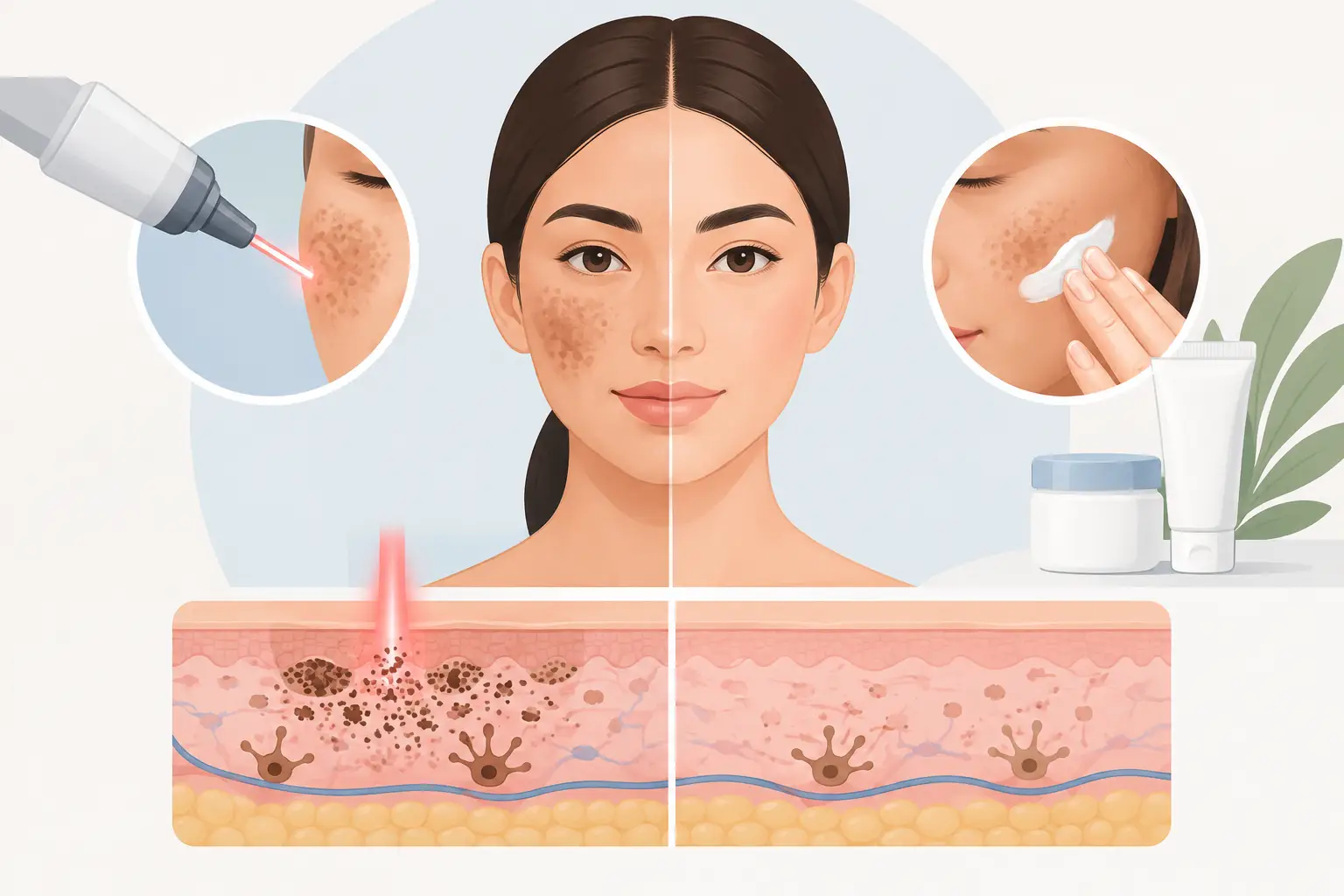
A brown patch that looks lighter one month and deeper the next can make melasma feel unpredictable. That is why the question of melasma laser versus topical creams is not simply about choosing the faster treatment. Melasma is a condition influenced by pigment activity, sun exposure, visible light, heat, hormones, and skin irritation. The most satisfying results usually come from choosing a treatment plan that respects all of those factors rather than pursuing a single dramatic step.
Melasma laser versus topical creams starts with the diagnosis
Melasma often appears as symmetrical tan, brown, or gray-brown patches across the cheeks, forehead, upper lip, or jawline. But not every dark spot is melasma. Sunspots, post-inflammatory hyperpigmentation after acne, medication-related pigmentation, and certain skin conditions can look similar at a glance.
This distinction matters because treatment that helps one type of discoloration can irritate another. Before discussing a laser or a cream, a clinician should assess the pattern, depth of color, your skin tone, current skincare routine, history of sensitivity, hormonal changes, and prior treatment response. A person whose melasma began during pregnancy, for example, may need a different timeline than someone whose pigmentation worsens after outdoor exercise or aggressive exfoliation.
Melasma also tends to be chronic. Treatment can fade visible pigment and help calm the pathways that produce it, but maintenance is often needed. A realistic plan aims for clearer, more even-looking skin while reducing the cycles of irritation and rebound darkening that can make melasma more noticeable.
What topical creams can do well
Topical treatment is often the foundation of melasma care because it can be adjusted gradually and used as part of long-term maintenance. Depending on the skin and the clinical assessment, a plan may include prescription ingredients such as hydroquinone, tretinoin, azelaic acid, tranexamic acid, cysteamine, or carefully selected combination formulas. Not every ingredient is right for every person, and some are used for defined periods rather than continuously.
These treatments work in different ways. Some slow pigment production, some encourage skin-cell turnover, and some help reduce inflammatory signals that can contribute to uneven color. The advantage is control: strength, frequency, and combinations can be tailored as the skin responds.
The trade-off is patience. Topicals typically need consistent use for weeks to months before meaningful improvement is visible. Overuse can cause redness, peeling, burning, or a weakened skin barrier. For melasma-prone skin, that irritation is not a small inconvenience. Inflammation can trigger more pigment, undermining the very goal of treatment.
A thoughtful topical routine should therefore feel sustainable. It may begin with a lower frequency, then build as tolerated. Gentle cleansing, barrier-supporting moisturizers, and a daily tinted broad-spectrum sunscreen with iron oxides are often just as relevant as the prescription cream itself. Visible light from daylight and screens is not the sole cause of melasma, but for many people, minimizing visible-light exposure is a useful part of pigment management.
When creams are often the better first step
Topicals are frequently appropriate when melasma is newly developing, when skin is reactive, when the pigment is diffuse rather than concentrated in a few spots, or when someone wants a conservative approach. They are also essential after procedures. Even when laser treatment is chosen, a well-tolerated home regimen helps protect and maintain the result.
Creams may be less satisfying when pigmentation has remained stubborn despite careful use, when a faster improvement is needed for a particular event, or when the person cannot maintain a consistent routine. Even then, the answer is not automatically a laser. The reason for limited progress should be reviewed first: inconsistent sunscreen use, ongoing irritation, hormonal triggers, or an incorrect diagnosis can all affect results.
Where laser treatment fits into a melasma plan
Laser and energy-based treatments can target excess pigment or encourage controlled skin renewal. In the right patient, with the right device and settings, they may brighten stubborn areas more quickly than creams alone. They can be useful as part of a carefully staged plan, especially when discoloration persists after the skin has been stabilized with topical care and sun protection.
However, melasma is not simply pigment sitting on the surface waiting to be removed. The condition involves highly active pigment cells and, in some cases, deeper changes in the skin. Heat and inflammation from an overly aggressive procedure can activate those cells. This is why a treatment that looks impressive immediately after a session may be followed by rebound darkening weeks later.
The risk is especially relevant for deeper skin tones and for anyone with a history of post-inflammatory hyperpigmentation. It does not mean laser treatment is off the table. It means device selection, energy level, treatment interval, and pre- and post-procedure care deserve careful planning. Lower-energy approaches and multiple conservative sessions may be preferable to one intense treatment.
A laser should not be a stand-alone promise
No responsible clinician should frame a laser as a permanent eraser for melasma. Results vary according to pigment depth, skin tone, hormonal influences, lifestyle, and aftercare. Sun exposure, heat, friction, and irritating skincare can still trigger recurrence.
A laser plan is strongest when it includes preparation and maintenance. The skin may need several weeks of gentle topical treatment before a procedure. Afterward, the focus shifts to soothing the barrier, avoiding unnecessary heat and friction, using diligent sun protection, and returning to pigment-control topicals at the appropriate time. The procedure is one component of care, not the entire strategy.
How to decide between the two
The decision is less about which option is universally better and more about what your skin needs now. A person with easily irritated skin and widespread, fluctuating pigmentation may benefit from a topical-first approach. Someone with stable melasma, good sun-protection habits, and persistent patches despite a consistent home regimen may be a candidate for a conservative procedure alongside ongoing topical care.
Your schedule and tolerance for maintenance also matter. Laser treatment involves appointments, recovery instructions, and the possibility of temporary redness or darkening. Topical care requires steady daily habits and can take time. Neither is effortless, and neither should be sold as one-size-fits-all.
During a consultation, useful questions include whether the discoloration is truly melasma, what may be triggering it, how your skin has reacted to products or procedures in the past, and what level of improvement is realistic. It is also reasonable to ask why a particular laser, peel, or prescription formula is being recommended for your skin rather than as part of a fixed package.
The overlooked treatment: preventing new pigment
People often focus on removing existing color, but preventing new pigment is what makes improvement last. Daily broad-spectrum SPF 30 or higher is a baseline, ideally reapplied when spending time outdoors. A tinted formula with iron oxides can be particularly helpful for people whose melasma is affected by visible light.
Protection also includes the smaller habits that are easy to overlook: avoiding scrubs that leave the skin stinging, not picking at blemishes, introducing active products one at a time, and using hats or shade during prolonged outdoor exposure. If heat appears to worsen your melasma, consider practical adjustments around saunas, hot yoga, intense outdoor workouts, or long periods in direct sun.
Hormonal influences deserve a gentle, individualized discussion as well. Pregnancy, certain contraceptives, and hormone therapy can affect melasma in some people. Do not stop prescribed medication solely because of pigmentation concerns, but bring the timing of changes to your medical provider and skin consultation.
A measured plan usually gives the best-looking result
For many patients, the most effective answer is not laser or cream. It is a sequence: first calm irritation and establish daily protection, then use targeted topicals, consider a conservative procedure only when it serves a clear purpose, and maintain the result with a routine the skin can comfortably sustain.
The goal is not to chase perfectly uniform skin under every light. It is to help your complexion look clearer, calmer, and more like itself without asking your skin to recover from unnecessary treatment. When melasma is approached with that level of care, each decision can be made with greater confidence and less pressure to do too much, too soon.







A brown patch that looks lighter one month and deeper the next can make melasma feel unpredictable. That is why the question of melasma laser versus topical creams is not simply about choosing the faster treatment. Melasma is a condition influenced by pigment activity, sun exposure, visible light, heat, hormones, and skin irritation. The most satisfying results usually come from choosing a treatment plan that respects all of those factors rather than pursuing a single dramatic step.
Melasma laser versus topical creams starts with the diagnosis
Melasma often appears as symmetrical tan, brown, or gray-brown patches across the cheeks, forehead, upper lip, or jawline. But not every dark spot is melasma. Sunspots, post-inflammatory hyperpigmentation after acne, medication-related pigmentation, and certain skin conditions can look similar at a glance.
This distinction matters because treatment that helps one type of discoloration can irritate another. Before discussing a laser or a cream, a clinician should assess the pattern, depth of color, your skin tone, current skincare routine, history of sensitivity, hormonal changes, and prior treatment response. A person whose melasma began during pregnancy, for example, may need a different timeline than someone whose pigmentation worsens after outdoor exercise or aggressive exfoliation.
Melasma also tends to be chronic. Treatment can fade visible pigment and help calm the pathways that produce it, but maintenance is often needed. A realistic plan aims for clearer, more even-looking skin while reducing the cycles of irritation and rebound darkening that can make melasma more noticeable.
What topical creams can do well
Topical treatment is often the foundation of melasma care because it can be adjusted gradually and used as part of long-term maintenance. Depending on the skin and the clinical assessment, a plan may include prescription ingredients such as hydroquinone, tretinoin, azelaic acid, tranexamic acid, cysteamine, or carefully selected combination formulas. Not every ingredient is right for every person, and some are used for defined periods rather than continuously.
These treatments work in different ways. Some slow pigment production, some encourage skin-cell turnover, and some help reduce inflammatory signals that can contribute to uneven color. The advantage is control: strength, frequency, and combinations can be tailored as the skin responds.
The trade-off is patience. Topicals typically need consistent use for weeks to months before meaningful improvement is visible. Overuse can cause redness, peeling, burning, or a weakened skin barrier. For melasma-prone skin, that irritation is not a small inconvenience. Inflammation can trigger more pigment, undermining the very goal of treatment.
A thoughtful topical routine should therefore feel sustainable. It may begin with a lower frequency, then build as tolerated. Gentle cleansing, barrier-supporting moisturizers, and a daily tinted broad-spectrum sunscreen with iron oxides are often just as relevant as the prescription cream itself. Visible light from daylight and screens is not the sole cause of melasma, but for many people, minimizing visible-light exposure is a useful part of pigment management.
When creams are often the better first step
Topicals are frequently appropriate when melasma is newly developing, when skin is reactive, when the pigment is diffuse rather than concentrated in a few spots, or when someone wants a conservative approach. They are also essential after procedures. Even when laser treatment is chosen, a well-tolerated home regimen helps protect and maintain the result.
Creams may be less satisfying when pigmentation has remained stubborn despite careful use, when a faster improvement is needed for a particular event, or when the person cannot maintain a consistent routine. Even then, the answer is not automatically a laser. The reason for limited progress should be reviewed first: inconsistent sunscreen use, ongoing irritation, hormonal triggers, or an incorrect diagnosis can all affect results.
Where laser treatment fits into a melasma plan
Laser and energy-based treatments can target excess pigment or encourage controlled skin renewal. In the right patient, with the right device and settings, they may brighten stubborn areas more quickly than creams alone. They can be useful as part of a carefully staged plan, especially when discoloration persists after the skin has been stabilized with topical care and sun protection.
However, melasma is not simply pigment sitting on the surface waiting to be removed. The condition involves highly active pigment cells and, in some cases, deeper changes in the skin. Heat and inflammation from an overly aggressive procedure can activate those cells. This is why a treatment that looks impressive immediately after a session may be followed by rebound darkening weeks later.
The risk is especially relevant for deeper skin tones and for anyone with a history of post-inflammatory hyperpigmentation. It does not mean laser treatment is off the table. It means device selection, energy level, treatment interval, and pre- and post-procedure care deserve careful planning. Lower-energy approaches and multiple conservative sessions may be preferable to one intense treatment.
A laser should not be a stand-alone promise
No responsible clinician should frame a laser as a permanent eraser for melasma. Results vary according to pigment depth, skin tone, hormonal influences, lifestyle, and aftercare. Sun exposure, heat, friction, and irritating skincare can still trigger recurrence.
A laser plan is strongest when it includes preparation and maintenance. The skin may need several weeks of gentle topical treatment before a procedure. Afterward, the focus shifts to soothing the barrier, avoiding unnecessary heat and friction, using diligent sun protection, and returning to pigment-control topicals at the appropriate time. The procedure is one component of care, not the entire strategy.
How to decide between the two
The decision is less about which option is universally better and more about what your skin needs now. A person with easily irritated skin and widespread, fluctuating pigmentation may benefit from a topical-first approach. Someone with stable melasma, good sun-protection habits, and persistent patches despite a consistent home regimen may be a candidate for a conservative procedure alongside ongoing topical care.
Your schedule and tolerance for maintenance also matter. Laser treatment involves appointments, recovery instructions, and the possibility of temporary redness or darkening. Topical care requires steady daily habits and can take time. Neither is effortless, and neither should be sold as one-size-fits-all.
During a consultation, useful questions include whether the discoloration is truly melasma, what may be triggering it, how your skin has reacted to products or procedures in the past, and what level of improvement is realistic. It is also reasonable to ask why a particular laser, peel, or prescription formula is being recommended for your skin rather than as part of a fixed package.
The overlooked treatment: preventing new pigment
People often focus on removing existing color, but preventing new pigment is what makes improvement last. Daily broad-spectrum SPF 30 or higher is a baseline, ideally reapplied when spending time outdoors. A tinted formula with iron oxides can be particularly helpful for people whose melasma is affected by visible light.
Protection also includes the smaller habits that are easy to overlook: avoiding scrubs that leave the skin stinging, not picking at blemishes, introducing active products one at a time, and using hats or shade during prolonged outdoor exposure. If heat appears to worsen your melasma, consider practical adjustments around saunas, hot yoga, intense outdoor workouts, or long periods in direct sun.
Hormonal influences deserve a gentle, individualized discussion as well. Pregnancy, certain contraceptives, and hormone therapy can affect melasma in some people. Do not stop prescribed medication solely because of pigmentation concerns, but bring the timing of changes to your medical provider and skin consultation.
A measured plan usually gives the best-looking result
For many patients, the most effective answer is not laser or cream. It is a sequence: first calm irritation and establish daily protection, then use targeted topicals, consider a conservative procedure only when it serves a clear purpose, and maintain the result with a routine the skin can comfortably sustain.
The goal is not to chase perfectly uniform skin under every light. It is to help your complexion look clearer, calmer, and more like itself without asking your skin to recover from unnecessary treatment. When melasma is approached with that level of care, each decision can be made with greater confidence and less pressure to do too much, too soon.