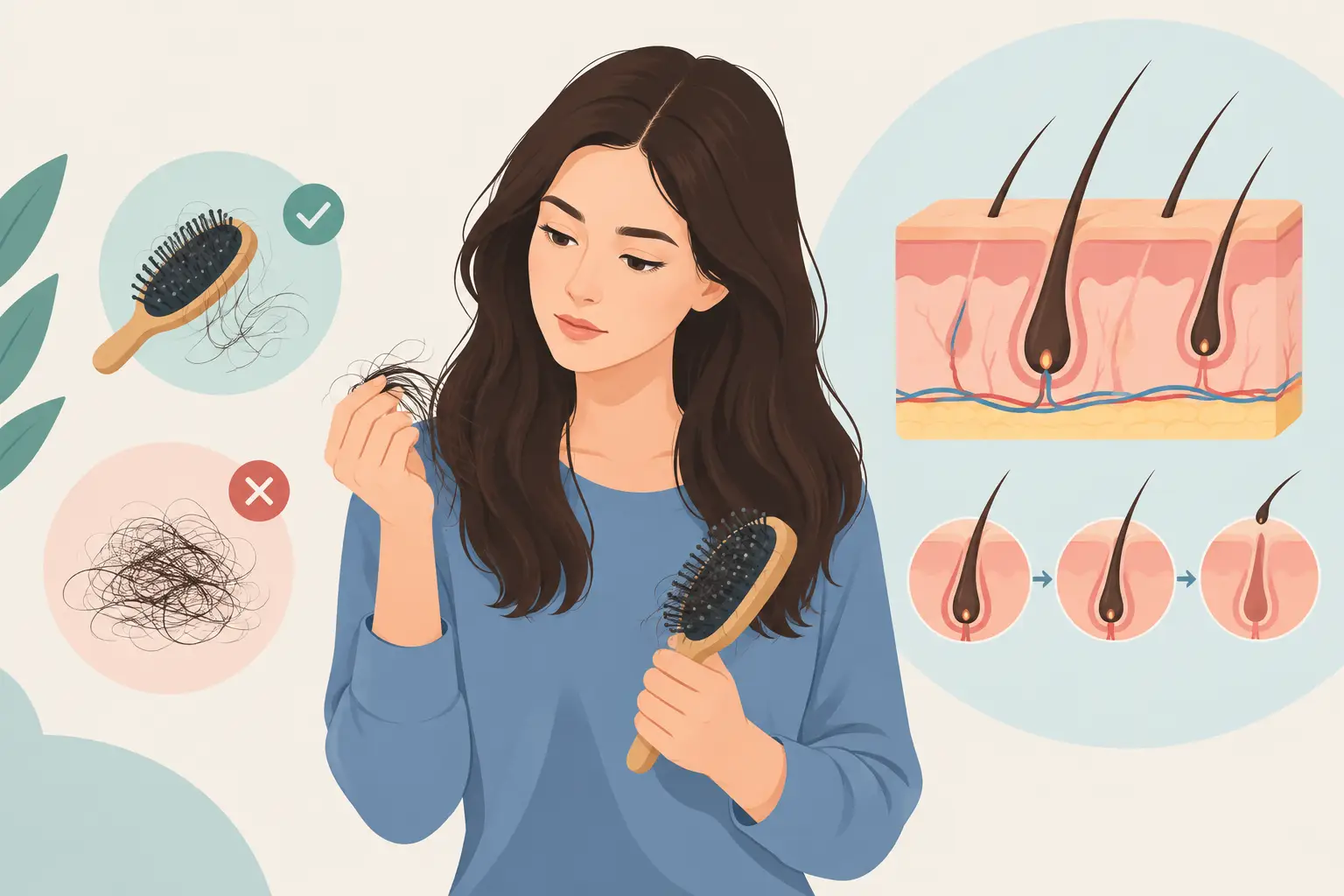
Seeing more strands around the shower drain or on your pillow can make an ordinary morning feel unsettling. Hair shedding is often part of the normal hair-growth cycle, but a noticeable change in the amount, duration, or pattern deserves thoughtful attention rather than guesswork.
A careful evaluation does not begin with choosing a supplement or treatment. It begins with understanding what has changed in your body, scalp, routine, and health. For some people, the right plan is reassurance and time. For others, early treatment can help protect density and support healthier regrowth.
What Is Normal Hair Shedding?
Each hair follicle moves through a cycle of active growth, transition, resting, and shedding. At any one time, some hairs are naturally in the resting phase and preparing to fall out. Losing roughly 50 to 100 hairs a day is commonly considered within a normal range, though counting individual strands is neither practical nor especially useful.
The more meaningful question is whether your shedding is different from your usual baseline. You may notice a larger bundle of hair after washing, more hairs on clothing, a wider part, less fullness in a ponytail, or greater visibility of the scalp under direct light. These observations do not automatically mean permanent hair loss, but they are useful details to share during a consultation.
Hair that comes out with a small white bulb at one end has usually completed its normal shedding phase. That bulb is not the root of the follicle itself. The follicle remains in the scalp and can produce another hair unless another condition is interfering with its function.
Why Hair Shedding Can Increase Suddenly
A common cause of diffuse shedding is telogen effluvium. This occurs when a larger-than-usual number of follicles shift into the resting phase at about the same time. The shedding often becomes apparent two to three months after a trigger, which can make the connection easy to miss.
Potential triggers include a high fever or infection, surgery, childbirth, rapid weight loss, restrictive eating, significant emotional stress, poor sleep, and a major change in medications. Low iron stores, thyroid conditions, and other nutritional or medical concerns may also play a role. Sometimes several smaller stressors accumulate rather than one dramatic event standing out.
Seasonal variation can also make shedding feel more noticeable. In addition, people with longer hair may see a more dramatic amount of hair in the brush simply because each strand is more visible. These factors can be reassuring context, but they should not dismiss a clear and persistent change in density.
Hair practices matter as well. Tight braids, extensions, frequent high-tension styling, bleaching, heat damage, and harsh chemical processes can cause breakage or traction-related hair loss. Breakage may look like shedding at first glance, but the hairs are often shorter and do not have the white club-shaped end seen with hairs that have naturally shed.
Hair Shedding Versus Pattern Hair Loss
Temporary shedding and pattern hair loss can occur separately, but they can also overlap. Pattern hair loss is influenced by genetics and hormonal sensitivity. It tends to progress gradually, often appearing as a widening center part or overall thinning at the crown in women, and recession or thinning at the temples and crown in men.
A period of increased shedding may bring an underlying pattern into view. Someone who has always had mild thinning, for example, may notice it more clearly after illness, stress, or postpartum shedding. This is why a plan based only on the amount of hair falling out can miss the larger picture.
The timeline is helpful. Telogen effluvium often begins abruptly and is spread relatively evenly across the scalp. Pattern loss tends to be slower and follows a recognizable distribution. Still, appearance alone is not always enough to tell the difference. A close scalp examination, review of your history, and when appropriate, laboratory testing can guide a more accurate diagnosis.
When Hair Shedding Needs Medical Attention
It is reasonable to schedule an evaluation if increased shedding lasts longer than a few months, continues to worsen, or is accompanied by visible thinning. Earlier assessment is particularly helpful when there is a family history of hair loss or when your part, hairline, or crown seems to be changing.
Some signs warrant more prompt care. These include distinct bald patches, scalp pain, burning, persistent itching, redness, scaling, pustules, or shiny areas where follicles appear absent. Sudden patchy loss may point to a condition such as alopecia areata, while inflammation or scarring conditions require timely medical attention to help protect the follicles.
It is also worth discussing shedding that occurs with fatigue, changes in menstrual cycles, unexplained weight change, cold intolerance, or symptoms of nutritional deficiency. Hair can reflect changes happening elsewhere in the body, so a scalp-focused concern should not be separated from your overall health.
A More Precise Way to Evaluate Hair Shedding
A useful hair consultation should feel unhurried and specific. The first step is to review when the change began and what happened in the preceding months. Illness, childbirth, dietary changes, emotional strain, new medications, recent procedures, and styling habits can each offer meaningful clues.
Next comes a careful examination of the scalp and the distribution of density. Your clinician may look for inflammation, scale, miniaturized hairs, breakage, or patterns that suggest a particular type of hair loss. Depending on your symptoms and medical history, blood work may be considered to evaluate concerns such as iron deficiency or thyroid dysfunction.
Photographs taken under consistent lighting can be valuable for monitoring progress. Hair growth is gradual, and day-to-day mirror checks often create more anxiety than clarity. Comparing standardized images over several months gives a more honest view of whether shedding has settled and whether density is changing.
At Somsei Clinic, a hair concern is approached as an individual medical question, not as a reason to automatically begin a package of treatments. The goal is to identify what your scalp and history suggest, explain the options clearly, and recommend only care that fits your condition and goals.
What Can Help, Depending on the Cause
The best next step depends on the diagnosis. When temporary shedding follows a trigger, the focus may be on correcting the underlying issue, supporting adequate nutrition, and allowing the growth cycle time to reset. Regrowth can begin before the hair looks visibly fuller, so patience is often part of appropriate care.
For pattern hair loss, earlier intervention may help preserve existing hairs and improve the appearance of density over time. Treatment options can include topical or oral medications when medically appropriate, scalp-based procedures, and personalized care plans that address inflammation or contributing scalp conditions. Each option has different benefits, limitations, costs, and potential side effects, so treatment should be selected after an informed discussion rather than from a one-size-fits-all recommendation.
Supplements can be useful when a documented deficiency exists, but more is not always better. Taking high doses of vitamins or minerals without a clear need may be unhelpful and, in some cases, harmful. A balanced diet with sufficient protein, iron-rich foods, and overall energy intake is generally more meaningful than relying on a single “hair vitamin.”
Gentle hair care also supports the process. Avoid repeated tight pulling, reduce unnecessary heat and chemical stress, and handle wet hair carefully. These habits cannot reverse every type of hair loss, but they can reduce breakage and make your hair look and feel healthier while medical treatment or recovery is underway.
Give the Process Enough Time
Hair responds slowly, even when the underlying trigger has been addressed. Shedding may take several months to settle, and visible improvement in density often takes longer because new hairs need time to grow. That pace can be frustrating, especially when you are watching your hair closely every day.
Instead of reacting to every strand, pay attention to the pattern: whether the shedding is ongoing, whether the scalp is becoming more visible, and whether there are symptoms such as irritation or patchy loss. A timely, careful assessment can replace uncertainty with a plan that respects both your health and your natural appearance.







Seeing more strands around the shower drain or on your pillow can make an ordinary morning feel unsettling. Hair shedding is often part of the normal hair-growth cycle, but a noticeable change in the amount, duration, or pattern deserves thoughtful attention rather than guesswork.
A careful evaluation does not begin with choosing a supplement or treatment. It begins with understanding what has changed in your body, scalp, routine, and health. For some people, the right plan is reassurance and time. For others, early treatment can help protect density and support healthier regrowth.
What Is Normal Hair Shedding?
Each hair follicle moves through a cycle of active growth, transition, resting, and shedding. At any one time, some hairs are naturally in the resting phase and preparing to fall out. Losing roughly 50 to 100 hairs a day is commonly considered within a normal range, though counting individual strands is neither practical nor especially useful.
The more meaningful question is whether your shedding is different from your usual baseline. You may notice a larger bundle of hair after washing, more hairs on clothing, a wider part, less fullness in a ponytail, or greater visibility of the scalp under direct light. These observations do not automatically mean permanent hair loss, but they are useful details to share during a consultation.
Hair that comes out with a small white bulb at one end has usually completed its normal shedding phase. That bulb is not the root of the follicle itself. The follicle remains in the scalp and can produce another hair unless another condition is interfering with its function.
Why Hair Shedding Can Increase Suddenly
A common cause of diffuse shedding is telogen effluvium. This occurs when a larger-than-usual number of follicles shift into the resting phase at about the same time. The shedding often becomes apparent two to three months after a trigger, which can make the connection easy to miss.
Potential triggers include a high fever or infection, surgery, childbirth, rapid weight loss, restrictive eating, significant emotional stress, poor sleep, and a major change in medications. Low iron stores, thyroid conditions, and other nutritional or medical concerns may also play a role. Sometimes several smaller stressors accumulate rather than one dramatic event standing out.
Seasonal variation can also make shedding feel more noticeable. In addition, people with longer hair may see a more dramatic amount of hair in the brush simply because each strand is more visible. These factors can be reassuring context, but they should not dismiss a clear and persistent change in density.
Hair practices matter as well. Tight braids, extensions, frequent high-tension styling, bleaching, heat damage, and harsh chemical processes can cause breakage or traction-related hair loss. Breakage may look like shedding at first glance, but the hairs are often shorter and do not have the white club-shaped end seen with hairs that have naturally shed.
Hair Shedding Versus Pattern Hair Loss
Temporary shedding and pattern hair loss can occur separately, but they can also overlap. Pattern hair loss is influenced by genetics and hormonal sensitivity. It tends to progress gradually, often appearing as a widening center part or overall thinning at the crown in women, and recession or thinning at the temples and crown in men.
A period of increased shedding may bring an underlying pattern into view. Someone who has always had mild thinning, for example, may notice it more clearly after illness, stress, or postpartum shedding. This is why a plan based only on the amount of hair falling out can miss the larger picture.
The timeline is helpful. Telogen effluvium often begins abruptly and is spread relatively evenly across the scalp. Pattern loss tends to be slower and follows a recognizable distribution. Still, appearance alone is not always enough to tell the difference. A close scalp examination, review of your history, and when appropriate, laboratory testing can guide a more accurate diagnosis.
When Hair Shedding Needs Medical Attention
It is reasonable to schedule an evaluation if increased shedding lasts longer than a few months, continues to worsen, or is accompanied by visible thinning. Earlier assessment is particularly helpful when there is a family history of hair loss or when your part, hairline, or crown seems to be changing.
Some signs warrant more prompt care. These include distinct bald patches, scalp pain, burning, persistent itching, redness, scaling, pustules, or shiny areas where follicles appear absent. Sudden patchy loss may point to a condition such as alopecia areata, while inflammation or scarring conditions require timely medical attention to help protect the follicles.
It is also worth discussing shedding that occurs with fatigue, changes in menstrual cycles, unexplained weight change, cold intolerance, or symptoms of nutritional deficiency. Hair can reflect changes happening elsewhere in the body, so a scalp-focused concern should not be separated from your overall health.
A More Precise Way to Evaluate Hair Shedding
A useful hair consultation should feel unhurried and specific. The first step is to review when the change began and what happened in the preceding months. Illness, childbirth, dietary changes, emotional strain, new medications, recent procedures, and styling habits can each offer meaningful clues.
Next comes a careful examination of the scalp and the distribution of density. Your clinician may look for inflammation, scale, miniaturized hairs, breakage, or patterns that suggest a particular type of hair loss. Depending on your symptoms and medical history, blood work may be considered to evaluate concerns such as iron deficiency or thyroid dysfunction.
Photographs taken under consistent lighting can be valuable for monitoring progress. Hair growth is gradual, and day-to-day mirror checks often create more anxiety than clarity. Comparing standardized images over several months gives a more honest view of whether shedding has settled and whether density is changing.
At Somsei Clinic, a hair concern is approached as an individual medical question, not as a reason to automatically begin a package of treatments. The goal is to identify what your scalp and history suggest, explain the options clearly, and recommend only care that fits your condition and goals.
What Can Help, Depending on the Cause
The best next step depends on the diagnosis. When temporary shedding follows a trigger, the focus may be on correcting the underlying issue, supporting adequate nutrition, and allowing the growth cycle time to reset. Regrowth can begin before the hair looks visibly fuller, so patience is often part of appropriate care.
For pattern hair loss, earlier intervention may help preserve existing hairs and improve the appearance of density over time. Treatment options can include topical or oral medications when medically appropriate, scalp-based procedures, and personalized care plans that address inflammation or contributing scalp conditions. Each option has different benefits, limitations, costs, and potential side effects, so treatment should be selected after an informed discussion rather than from a one-size-fits-all recommendation.
Supplements can be useful when a documented deficiency exists, but more is not always better. Taking high doses of vitamins or minerals without a clear need may be unhelpful and, in some cases, harmful. A balanced diet with sufficient protein, iron-rich foods, and overall energy intake is generally more meaningful than relying on a single “hair vitamin.”
Gentle hair care also supports the process. Avoid repeated tight pulling, reduce unnecessary heat and chemical stress, and handle wet hair carefully. These habits cannot reverse every type of hair loss, but they can reduce breakage and make your hair look and feel healthier while medical treatment or recovery is underway.
Give the Process Enough Time
Hair responds slowly, even when the underlying trigger has been addressed. Shedding may take several months to settle, and visible improvement in density often takes longer because new hairs need time to grow. That pace can be frustrating, especially when you are watching your hair closely every day.
Instead of reacting to every strand, pay attention to the pattern: whether the shedding is ongoing, whether the scalp is becoming more visible, and whether there are symptoms such as irritation or patchy loss. A timely, careful assessment can replace uncertainty with a plan that respects both your health and your natural appearance.