A change in your face after filler can be unsettling, especially when it appears weeks or months after treatment. Searching for filler migration symptoms may bring up alarming images, but not every bump, shadow, or area of puffiness means filler has moved. A careful assessment matters because several common concerns can look similar from the mirror.
Dermal filler is meant to support or restore volume in a specific tissue plane. When the result no longer looks as expected, the right next step is not to assume the worst or add more product to “balance” it. It is to understand what has changed, why it may have changed, and whether observation, treatment, or simply time is appropriate.
What does filler migration mean?
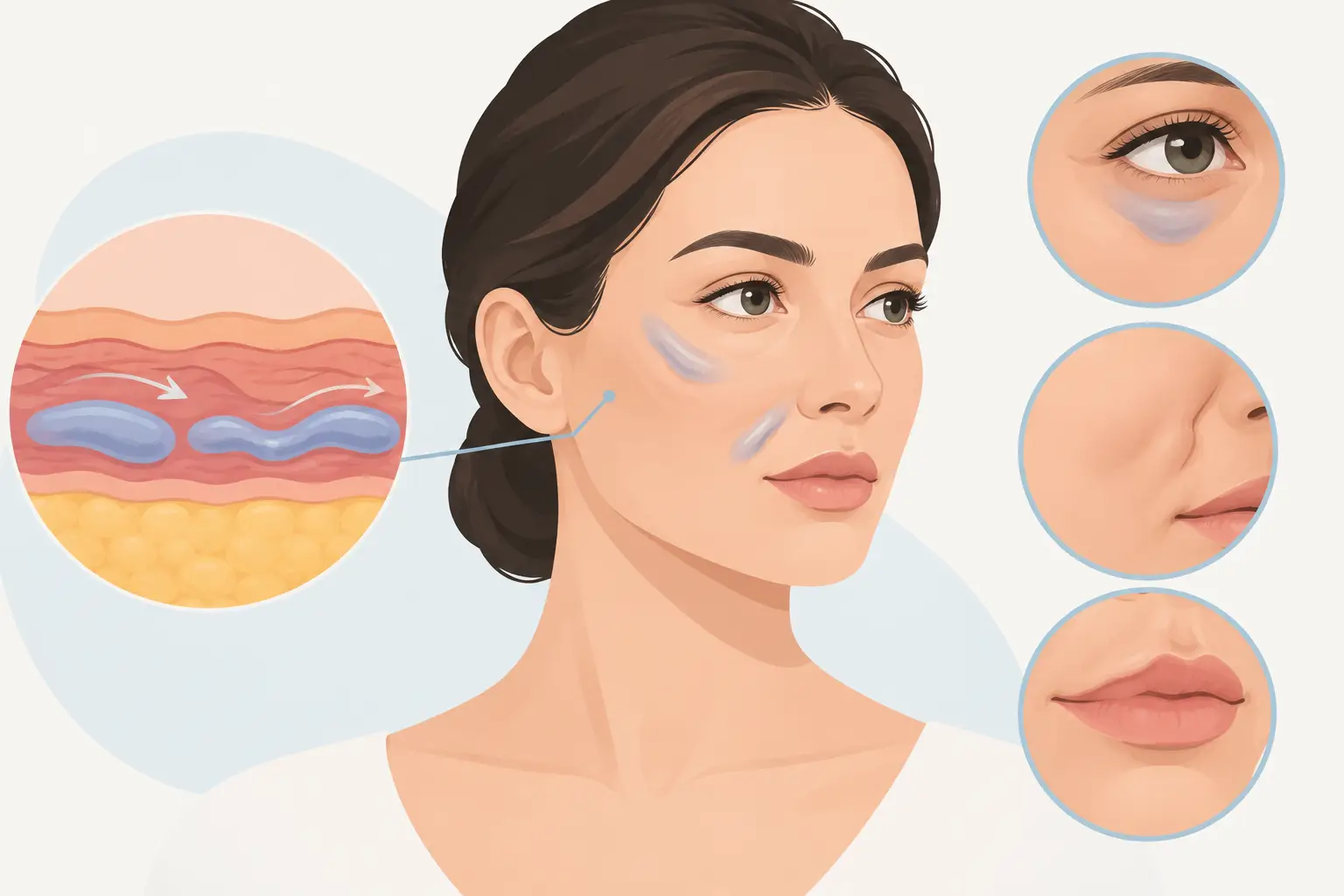
Filler migration refers to filler material being present beyond the intended treatment area. It may occur when product spreads into adjacent tissue, is placed in a plane that does not hold it predictably, or gradually shifts with repeated movement, pressure, and the natural behavior of soft tissue.
The term is often used loosely online. In reality, a fuller appearance near a treated area may also be caused by swelling, retained fluid, normal tissue movement, a preexisting contour becoming more visible, or too much filler being placed in the original area. These are different issues and may call for very different solutions.
Hyaluronic acid fillers are the most commonly discussed because they can often be dissolved when medically appropriate. However, the approach depends on the filler type, the location, the timing of treatment, and a clinician’s examination. A photograph alone rarely tells the whole story.
Filler migration symptoms that may need evaluation
Migration does not always cause pain. More often, people notice a change in shape, texture, or facial balance. The concern may be subtle at first, such as an area that looks puffy in certain lighting or feels different when applying makeup.
Fullness outside the intended treatment area
One of the more recognizable signs is volume appearing just beyond where filler was placed. For example, filler intended for the lips may appear as persistent fullness above the upper lip, sometimes described as a “shelf” or mustache-like swelling. Under-eye filler concerns may present as puffiness along the upper cheek or lower eyelid rather than a smooth transition between them.
This does not automatically confirm migration. Lip anatomy, natural asymmetry, temporary swelling, and the amount of product placed can create a similar appearance. The timing of the change is useful information: swelling is more likely to improve over days or weeks, while a stable contour change that persists may warrant a closer review.
A firm lump, ridge, or uneven texture
A palpable bump can occur after filler for several reasons. It may be product sitting in a concentrated area, local swelling, scar-like tissue response, or, less commonly, an inflammatory nodule. A migrated deposit may feel like a small area of fullness away from the intended injection site.
Avoid repeatedly pressing, massaging, or trying to flatten a lump on your own unless your treating clinician specifically advised it. Aggressive manipulation can irritate tissue and may make swelling worse. Note when you first noticed the change, whether it is tender, and whether it fluctuates over time.
Persistent puffiness that changes through the day
Some areas of the face, particularly around the eyes and upper cheeks, are prone to fluid retention. Hyaluronic acid attracts water, which can make a previously subtle amount of filler look more noticeable after salty meals, alcohol, poor sleep, allergies, or seasonal changes.
Puffiness that is worse in the morning and improves later in the day can suggest a fluid-related component. This is not the same as true migration, but it is still worth discussing if the appearance is persistent or bothersome. The under-eye area requires especially conservative decision-making because the skin is thin and the lymphatic drainage is delicate.
An altered smile or facial expression
If filler sits where it affects movement or changes the way light reflects from the face, expressions can look different. You may notice a less defined lip border, a heavier appearance around the mouth, or fullness that becomes more apparent when smiling.
A change in expression can also result from swelling or from filler that was intentionally placed to support nearby lines. The key question is whether the result looks and feels natural in motion, not just at rest. A skilled evaluation considers your facial movement, not only a single front-facing photo.
What can look like migration but is not
The internet has made people understandably alert to filler complications, but it can also encourage self-diagnosis. Several concerns are commonly mistaken for migration.
Early swelling is the most frequent example. Depending on the treatment area and product used, swelling can take days to settle and may briefly appear uneven. Bruising can alter shadows and make one side look fuller. Inflammation from a recent dental procedure, illness, vaccination, allergy flare, or skin irritation may also make previously placed filler look more prominent.
Overfilling is another possibility. When too much volume is placed in the intended area, the face can look broad, puffy, or less defined without the filler having physically moved elsewhere. This distinction matters. Treating apparent migration by adding more filler can compound the concern rather than correct it.
Natural aging and changes in body weight can also change how filler appears over time. As facial fat pads, skin elasticity, and bone structure change, a result that once looked balanced may no longer suit the surrounding tissue in the same way. This is one reason a conservative, long-term treatment plan is often more reliable than frequent touch-ups.
When symptoms require prompt medical attention
Most concerns about filler migration are not emergencies, but some symptoms after any filler injection should be treated urgently. Severe or increasing pain, skin that turns pale, gray, blue, or mottled, blistering, unusual coldness of the skin, or visual changes require immediate medical evaluation. These symptoms can indicate a vascular complication, which is different from migration and time-sensitive.
Seek prompt care as well for significant redness, warmth, worsening tenderness, drainage, fever, or rapidly increasing swelling. These may point to infection or inflammation. Do not wait for an online opinion or attempt to treat these signs at home.
If a concern develops weeks, months, or even longer after treatment, schedule an in-person consultation rather than assuming it is harmless or irreversible. Bring details if you have them: the filler brand, injection area, approximate amount, date of treatment, and any prior dissolving treatments. Before-and-after photos can be helpful, particularly photos taken before treatment and after swelling resolved.
How a thoughtful assessment guides treatment
The goal of evaluation is not simply to decide whether filler should be dissolved. First, the clinician needs to identify whether filler is likely involved, where it may be located, and whether the issue is volume, edema, inflammation, or another skin and tissue concern.
In some cases, no immediate intervention is needed. Observation may be reasonable when symptoms are mild and likely related to healing or fluctuating fluid retention. In others, a carefully planned hyaluronidase treatment may be considered for hyaluronic acid filler. Dissolving should be approached with precision, as it can affect the treated area’s appearance and may need to be staged rather than performed aggressively.
Not all fillers respond to hyaluronidase, and not all contour concerns should be treated with it. This is why knowing what was injected is valuable. If the product history is unclear, an experienced clinician may use examination, imaging when appropriate, and a conservative treatment plan to reduce uncertainty.
At Somsei Clinic, the approach to aesthetic concerns begins with listening to what has changed and examining the face as a whole. Rather than rushing to add or remove product, a one-on-one consultation can help clarify what is actually present and what would best preserve a natural expression.
Protecting a natural result over time
The best way to reduce the chance of unwanted filler changes is not a single technique or product. It is a plan that respects facial anatomy, tissue quality, prior treatments, and your preference for a subtle result. Conservative dosing, appropriate placement, and enough time between treatments allow both you and your clinician to see the true outcome before making another decision.
If you are worried about filler migration symptoms, try not to judge the change only through close-up selfies or a difficult day in the mirror. A calm, detailed examination can distinguish a temporary change from a concern that needs treatment - and help you choose only the care that is genuinely necessary.







A change in your face after filler can be unsettling, especially when it appears weeks or months after treatment. Searching for filler migration symptoms may bring up alarming images, but not every bump, shadow, or area of puffiness means filler has moved. A careful assessment matters because several common concerns can look similar from the mirror.
Dermal filler is meant to support or restore volume in a specific tissue plane. When the result no longer looks as expected, the right next step is not to assume the worst or add more product to “balance” it. It is to understand what has changed, why it may have changed, and whether observation, treatment, or simply time is appropriate.
What does filler migration mean?
Filler migration refers to filler material being present beyond the intended treatment area. It may occur when product spreads into adjacent tissue, is placed in a plane that does not hold it predictably, or gradually shifts with repeated movement, pressure, and the natural behavior of soft tissue.
The term is often used loosely online. In reality, a fuller appearance near a treated area may also be caused by swelling, retained fluid, normal tissue movement, a preexisting contour becoming more visible, or too much filler being placed in the original area. These are different issues and may call for very different solutions.
Hyaluronic acid fillers are the most commonly discussed because they can often be dissolved when medically appropriate. However, the approach depends on the filler type, the location, the timing of treatment, and a clinician’s examination. A photograph alone rarely tells the whole story.
Filler migration symptoms that may need evaluation
Migration does not always cause pain. More often, people notice a change in shape, texture, or facial balance. The concern may be subtle at first, such as an area that looks puffy in certain lighting or feels different when applying makeup.
Fullness outside the intended treatment area
One of the more recognizable signs is volume appearing just beyond where filler was placed. For example, filler intended for the lips may appear as persistent fullness above the upper lip, sometimes described as a “shelf” or mustache-like swelling. Under-eye filler concerns may present as puffiness along the upper cheek or lower eyelid rather than a smooth transition between them.
This does not automatically confirm migration. Lip anatomy, natural asymmetry, temporary swelling, and the amount of product placed can create a similar appearance. The timing of the change is useful information: swelling is more likely to improve over days or weeks, while a stable contour change that persists may warrant a closer review.
A firm lump, ridge, or uneven texture
A palpable bump can occur after filler for several reasons. It may be product sitting in a concentrated area, local swelling, scar-like tissue response, or, less commonly, an inflammatory nodule. A migrated deposit may feel like a small area of fullness away from the intended injection site.
Avoid repeatedly pressing, massaging, or trying to flatten a lump on your own unless your treating clinician specifically advised it. Aggressive manipulation can irritate tissue and may make swelling worse. Note when you first noticed the change, whether it is tender, and whether it fluctuates over time.
Persistent puffiness that changes through the day
Some areas of the face, particularly around the eyes and upper cheeks, are prone to fluid retention. Hyaluronic acid attracts water, which can make a previously subtle amount of filler look more noticeable after salty meals, alcohol, poor sleep, allergies, or seasonal changes.
Puffiness that is worse in the morning and improves later in the day can suggest a fluid-related component. This is not the same as true migration, but it is still worth discussing if the appearance is persistent or bothersome. The under-eye area requires especially conservative decision-making because the skin is thin and the lymphatic drainage is delicate.
An altered smile or facial expression
If filler sits where it affects movement or changes the way light reflects from the face, expressions can look different. You may notice a less defined lip border, a heavier appearance around the mouth, or fullness that becomes more apparent when smiling.
A change in expression can also result from swelling or from filler that was intentionally placed to support nearby lines. The key question is whether the result looks and feels natural in motion, not just at rest. A skilled evaluation considers your facial movement, not only a single front-facing photo.
What can look like migration but is not
The internet has made people understandably alert to filler complications, but it can also encourage self-diagnosis. Several concerns are commonly mistaken for migration.
Early swelling is the most frequent example. Depending on the treatment area and product used, swelling can take days to settle and may briefly appear uneven. Bruising can alter shadows and make one side look fuller. Inflammation from a recent dental procedure, illness, vaccination, allergy flare, or skin irritation may also make previously placed filler look more prominent.
Overfilling is another possibility. When too much volume is placed in the intended area, the face can look broad, puffy, or less defined without the filler having physically moved elsewhere. This distinction matters. Treating apparent migration by adding more filler can compound the concern rather than correct it.
Natural aging and changes in body weight can also change how filler appears over time. As facial fat pads, skin elasticity, and bone structure change, a result that once looked balanced may no longer suit the surrounding tissue in the same way. This is one reason a conservative, long-term treatment plan is often more reliable than frequent touch-ups.
When symptoms require prompt medical attention
Most concerns about filler migration are not emergencies, but some symptoms after any filler injection should be treated urgently. Severe or increasing pain, skin that turns pale, gray, blue, or mottled, blistering, unusual coldness of the skin, or visual changes require immediate medical evaluation. These symptoms can indicate a vascular complication, which is different from migration and time-sensitive.
Seek prompt care as well for significant redness, warmth, worsening tenderness, drainage, fever, or rapidly increasing swelling. These may point to infection or inflammation. Do not wait for an online opinion or attempt to treat these signs at home.
If a concern develops weeks, months, or even longer after treatment, schedule an in-person consultation rather than assuming it is harmless or irreversible. Bring details if you have them: the filler brand, injection area, approximate amount, date of treatment, and any prior dissolving treatments. Before-and-after photos can be helpful, particularly photos taken before treatment and after swelling resolved.
How a thoughtful assessment guides treatment
The goal of evaluation is not simply to decide whether filler should be dissolved. First, the clinician needs to identify whether filler is likely involved, where it may be located, and whether the issue is volume, edema, inflammation, or another skin and tissue concern.
In some cases, no immediate intervention is needed. Observation may be reasonable when symptoms are mild and likely related to healing or fluctuating fluid retention. In others, a carefully planned hyaluronidase treatment may be considered for hyaluronic acid filler. Dissolving should be approached with precision, as it can affect the treated area’s appearance and may need to be staged rather than performed aggressively.
Not all fillers respond to hyaluronidase, and not all contour concerns should be treated with it. This is why knowing what was injected is valuable. If the product history is unclear, an experienced clinician may use examination, imaging when appropriate, and a conservative treatment plan to reduce uncertainty.
At Somsei Clinic, the approach to aesthetic concerns begins with listening to what has changed and examining the face as a whole. Rather than rushing to add or remove product, a one-on-one consultation can help clarify what is actually present and what would best preserve a natural expression.
Protecting a natural result over time
The best way to reduce the chance of unwanted filler changes is not a single technique or product. It is a plan that respects facial anatomy, tissue quality, prior treatments, and your preference for a subtle result. Conservative dosing, appropriate placement, and enough time between treatments allow both you and your clinician to see the true outcome before making another decision.
If you are worried about filler migration symptoms, try not to judge the change only through close-up selfies or a difficult day in the mirror. A calm, detailed examination can distinguish a temporary change from a concern that needs treatment - and help you choose only the care that is genuinely necessary.